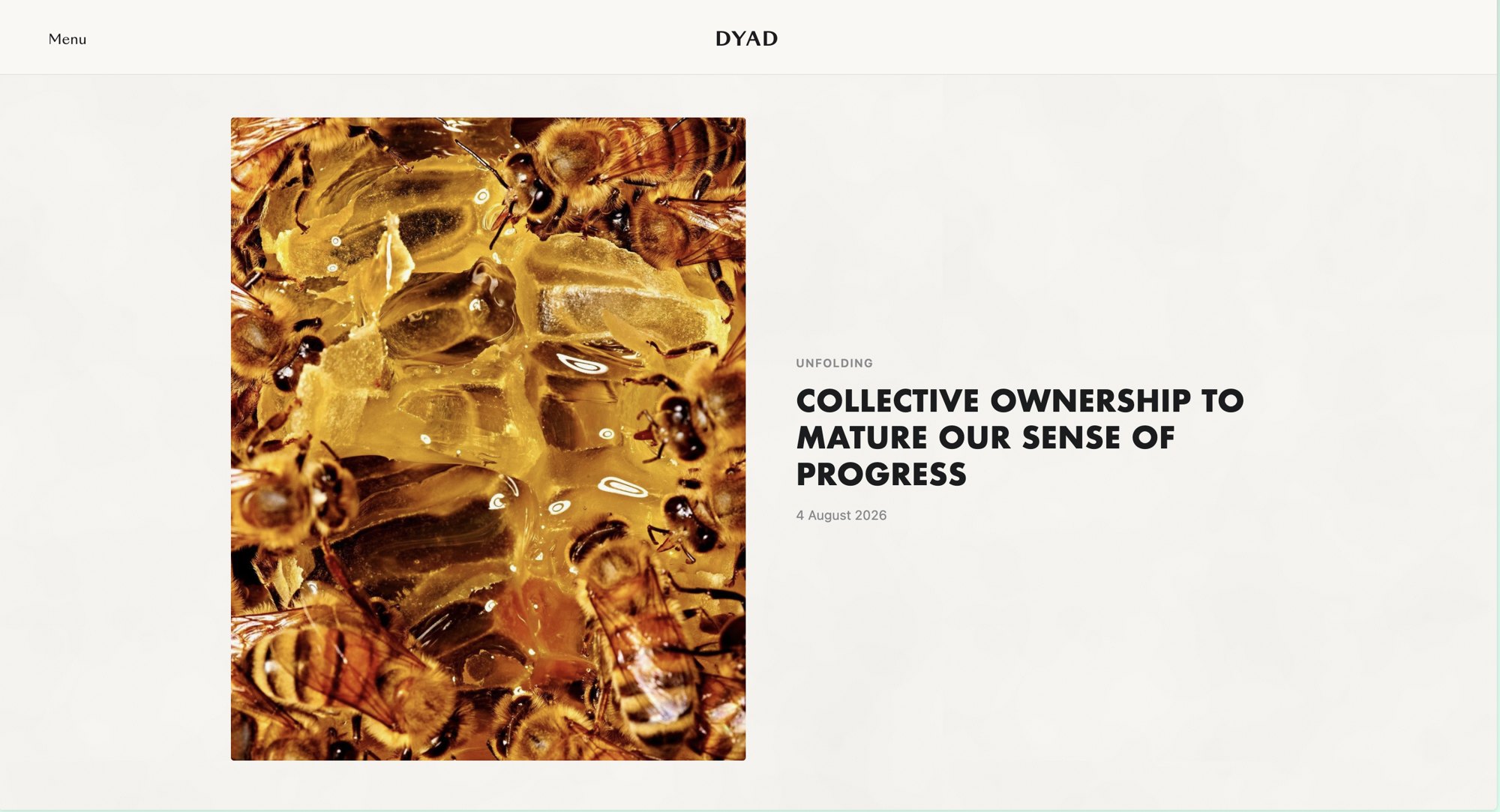
Mercer Hotel bees by Bobby Doherty for At Large Magazine
Ownership determines whose interests prevail.
Marjorie Kelly
In July 2024, The Consilience Project published one of the clearest, most consequential accounts of the progress narrative shaping this late-stage capitalist era. They question the belief that technological innovation, economic growth, markets, and our institutions together produce a steady improvement in human life, as well as the incentives sustaining this story and the risks created by its narrow definition. When progress is measured primarily through economic and military growth, it downplays the scale of its side effects and treats social and ecological costs as collateral, weakening the very conditions on which life and wellbeing depend. Their conclusion that our current idea of progress is immature and developmentally incomplete offers fertile ground for the deep, long-term thinking this moment demands of all changemaking efforts.
Looking through this lens at why social platforms, many of them built to solve genuine problems or serve relational needs, have become sources of widespread harm, ownership appears closest to the heart of the problem. It is where the incentives shaping behaviour inside the organisation, and the behaviours the platform itself goes on to reward, normalise, and scale, are set. Ownership determines who has the power to define pace and progress, whose interests are represented when tradeoffs arise, who receives the economic benefits, and who is left to carry the costs. It shapes what an organisation is ultimately structured to stay true to.
In the corporate ownership model that dominates the technology ecosystem, ownership, and therefore steering power, is concentrated among a narrow group of founders and funders. Their priorities have formal standing inside the organisation, while the people whose participation, and relationships make the platform valuable have little structural influence over its trajectory. When the interests of these groups conflict, the structure gives the financial interests of shareholders priority over the wellbeing and rights of all other stakeholders. The companies change, but the logic remains the same. Internalise profit and externalise the costs onto society and the living world.
We have seen this play out enough for a term to be coined for it. The marvellous, quick-witted digital rights activist and science fiction author Cory Doctorow calls it enshittification. With it, he names the process by which platforms first create value for users and lock them in, then create value for business customers and lock them in, before progressively extracting from both. The point is not simply that platforms deteriorate, but that they are deliberately made worse without meaningful accountability. The most consequential truth to confront here is that they do it because they can. Internally, they are answerable to an ownership model that makes growth and financial return binding, while treating nearly everything else as a means to those ends. Externally, the institutions meant to hold this power to account are increasingly entangled with it.
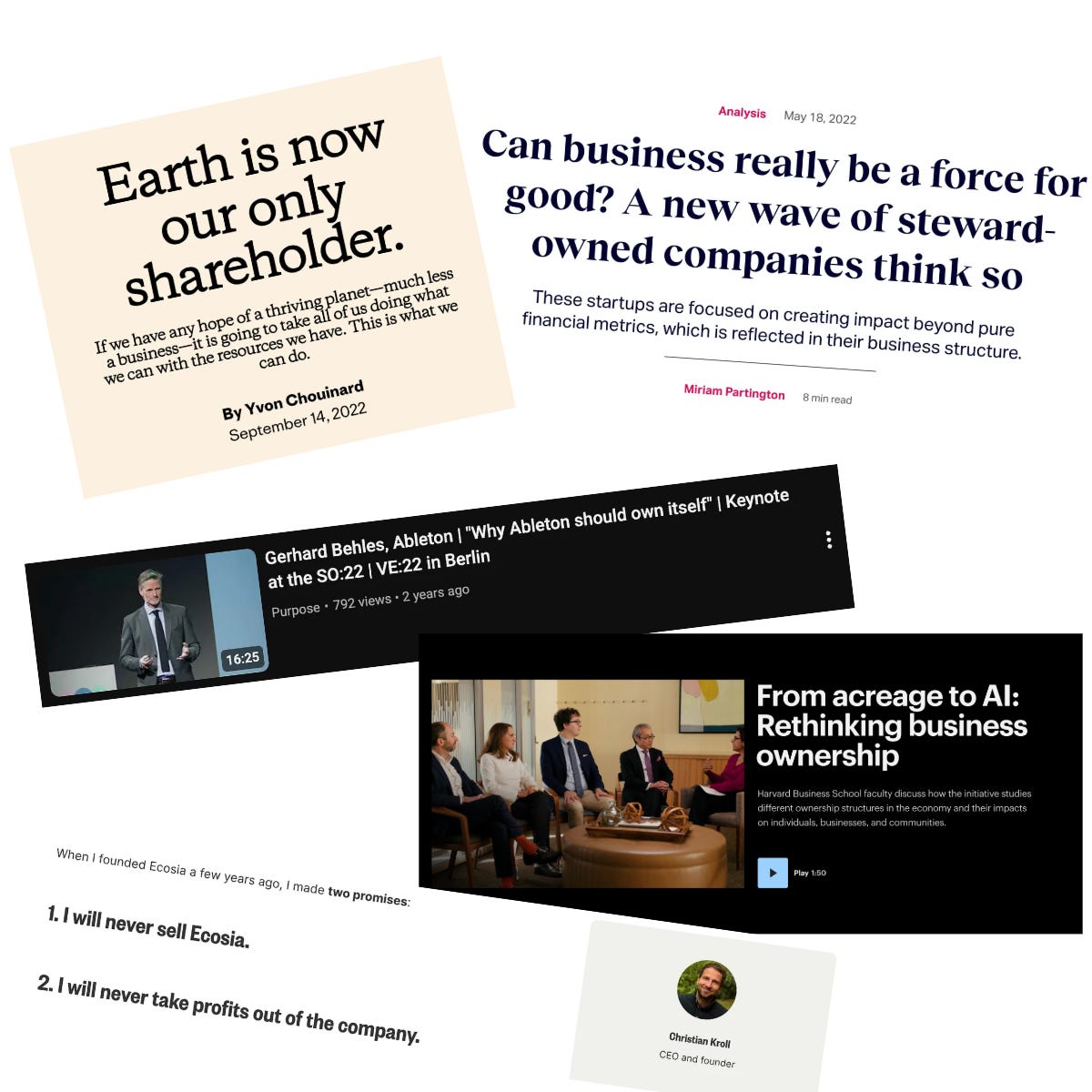
A different ownership architecture offers a response at the source. Collective ownership changes who has standing when decisions are made, bringing the people who create and sustain a platform's value into the structures that define progress, establish priorities, and decide which tradeoffs can be accepted. Steward ownership adds another safeguard by separating control from capital. Steering power remains with people connected to the organisation and its purpose, while profit becomes a means of sustaining that purpose rather than an end to be extracted by owners. The consequences of a decision become harder to push outward when the people carrying them have a place in making it, and when the structure itself limits how much value and power can be privately accumulated.
At Dyad, we are putting this commitment into practice by building governance alongside the product and preparing for a transition to steward ownership from the outset. Active community members will gain a role in shaping its rules, priorities, and direction. This means giving up the conventional promise of an eventual sale for private gain, because we believe value created collectively should not be captured by a few. None of this guarantees wiser decisions, but it changes the baseline by giving those affected real standing and making accountability part of the organisation rather than a matter of goodwill.
We offer this not as a finished answer, but as an invitation for the innovative thinking that has transformed products and interfaces over the past three decades to reach the level of ownership itself. To mature our sense of progress, we need to move away from individualistic structures organised around private accumulation and unilateral control, and toward communal forms of ownership and governance that recognise our interdependence, distribute power, and allow those affected to help determine the direction. Progress cannot remain something defined by a few, imposed on many, and judged by how much value can be privately captured. It must become something we shape, govern, and hold in common.
Volume Rendering CT Scans by voxel123
A problem well stated is a problem half solved.
Charles F. Kettering
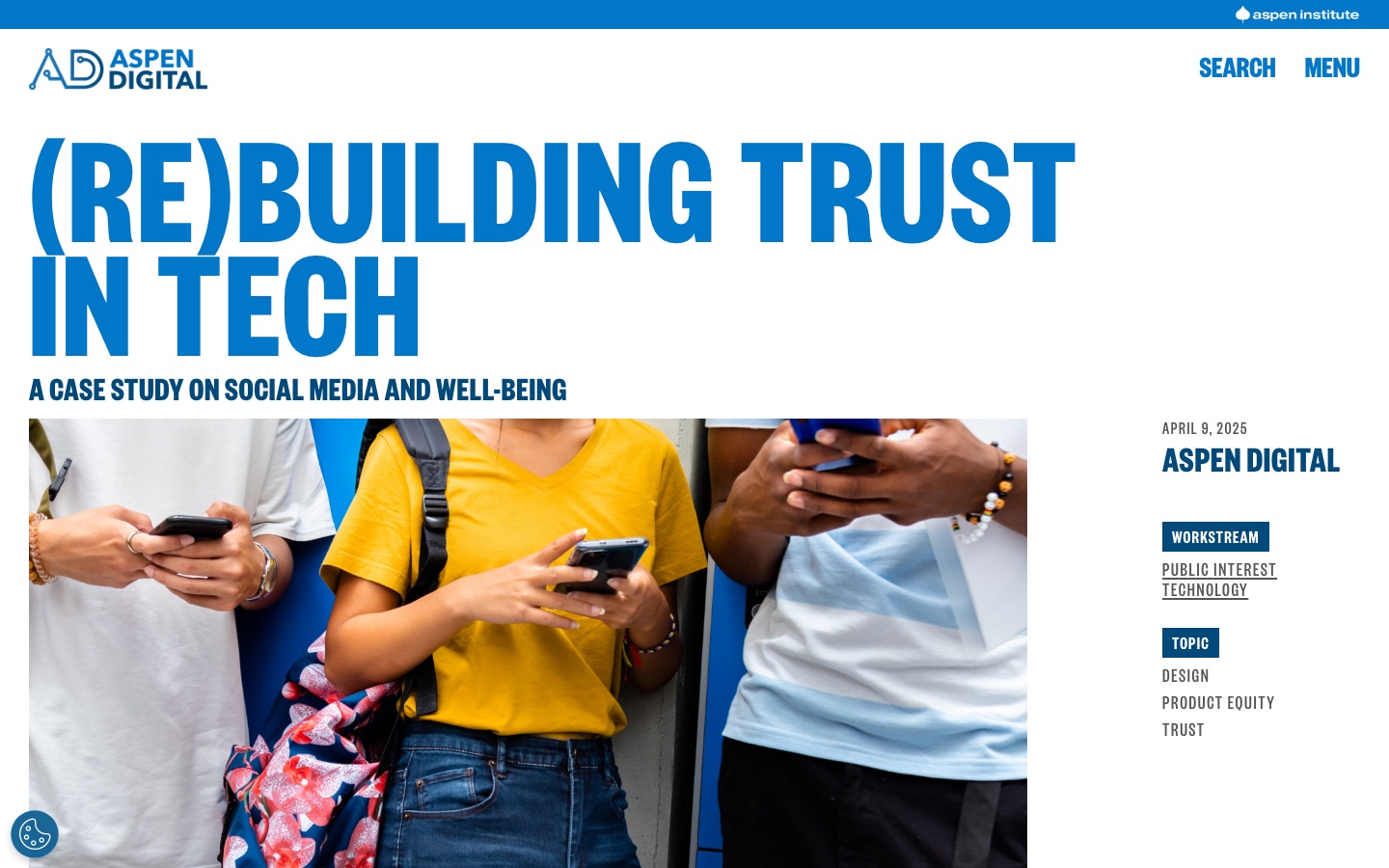
Climate online has grown increasingly commodified, and hostile. The desire to connect and exchange, once held as the emancipatory promise of the World Wide Web, is now met by systems that capture and translate our lives into data, extracting from our relationships, expressions, and attention in ways that mirror colonial patterns of exploitation. For many of us, the internet has become a source of stress, overwhelm, and abuse. These harms fall first and hardest on people who are marginalized by collective structures of oppression, but the systems that produce them reorder life for everyone.
The scale and scope of the harm is difficult to overstate here. From loneliness and declining mental health, to information warfare, political polarization, the erosion of trust in institutions, and democratic instability, the effects of opaque and self-serving social technology corporations' operations increasingly reach far beyond the screen. The move from our own lived experience into a deeper study of how these systems work brought about the realization that these platforms are not accidentally producing these outcomes.
They are working exactly as they were built to work. Once behavioral data was identified as a new frontier of extraction, platforms developed increasingly sophisticated ways to capture, repurpose, and sell it, with consent reduced to an unreadable ritual demanded as the price of participation. In the process, they ceased to be social technologies serving the people who use them and became surveillance machinery built to profit from prediction, attention capture, and ultimately, behavior manipulation.
In this state of disillusionment, we kept peeling back the layers. From seemingly small design decisions to the metrics beneath them, the revenue models they serve, and in effect, the ownership and governance structures that allows for and perpetuate this extractive behavior. We encountered incentives, concentrations of power, and forms of decision-making that remained largely invisible to the people most affected by them.
This brought us to a simple conviction: The problem with the status quo of social technologies is systemic, and so must be the response.
We are therefore not interested in one-off interventions, nor in building a gentler interface on top of the same underlying logic. Our approach here is to surface what is least seen. Who owns the platforms we meet on? What incentives does that ownership create? What kinds of design decisions follow from those incentives? What behaviors do those designs allow for, reward, or distort? Who benefits from the system as it runs now? Who is harmed by it? Who can inspect its workings, contest its decisions, and shape it back?
Looking to previous struggles for liberation, civil rights, and social justice, we find a common lesson. Durable change begins by understanding the forces that produce a problem, and is carried forward through sustained collective action. It is within this long arc that we position our work and our commitment to building social technology in service of community and collective sensemaking, with safeguards embedded in its code and operations through open-source infrastructure, collective ownership, and participatory governance.
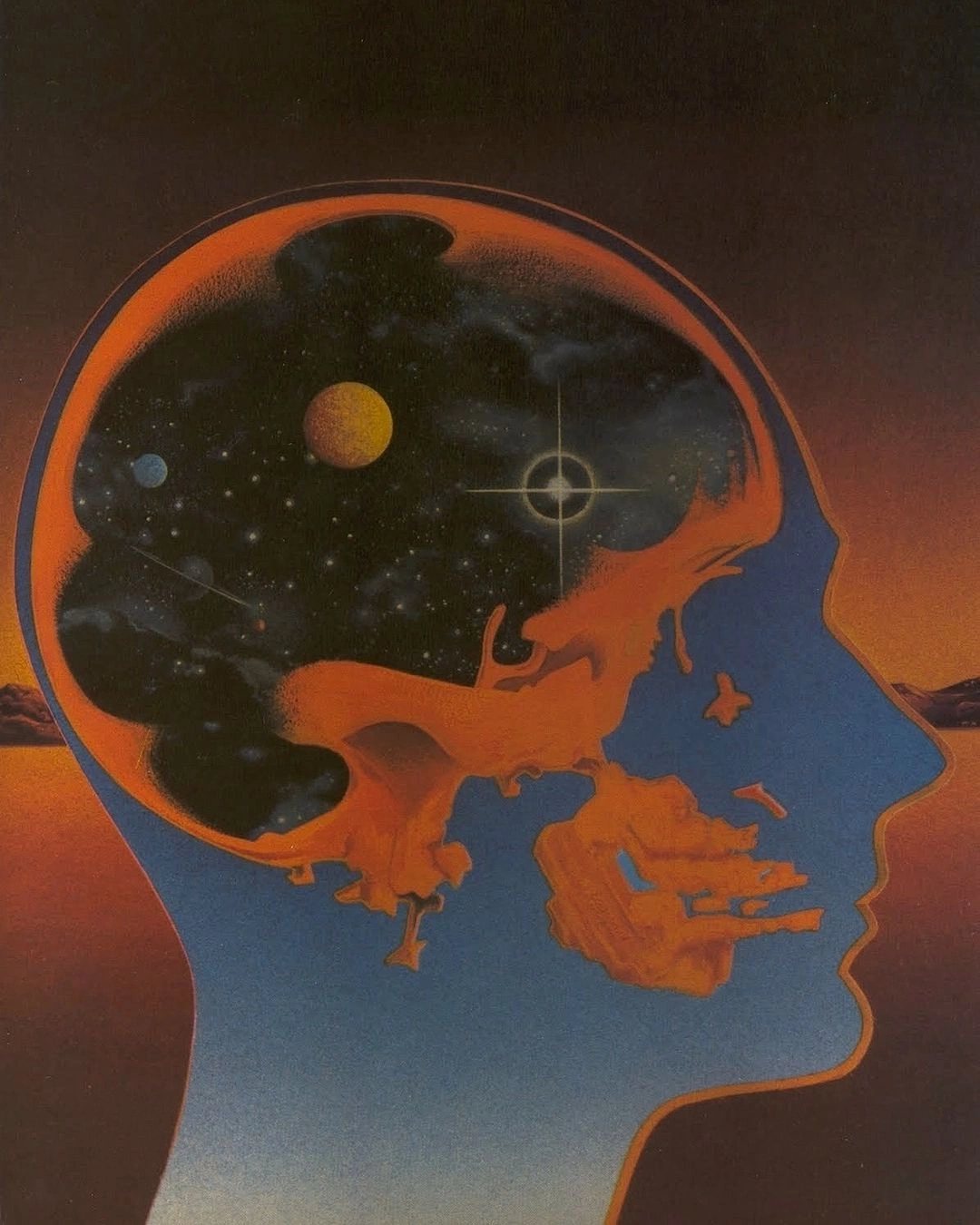
Charts Of The Soul by illustrator Peter Goodfellow for Omni magazine, 1983.
We humanize what is going on in the world and in ourselves only by speaking of it.
Hannah Arendt, Men in Dark Times
Over the past two years now, we have been meticulously at work. Working first to understand how we arrived at a digital environment that feels so intrusive, hostile, exhausting, and then to build new world precious, full of life by virtue of serving the life within. Dyad is the product of such care and intention.
We did not like how being social online felt. We lacked the humanity the platforms we meet on allowed for. We are stripped down to a certain version of ourselves, and not the version we wanted to come forth. The complexity of our experiences, the intricacy of making sense of them, and with that, discovering and nurturing the meaning of our lives.
Where do you go online to expand, deepen, texture?
A face to face conversation is part of the oral culture we only recently parted ways with. Stories and conversations have so long been how we weave parts of us together. With Dyad, we want to give way to more of them, initiated and discovered on our collectively consented terms.
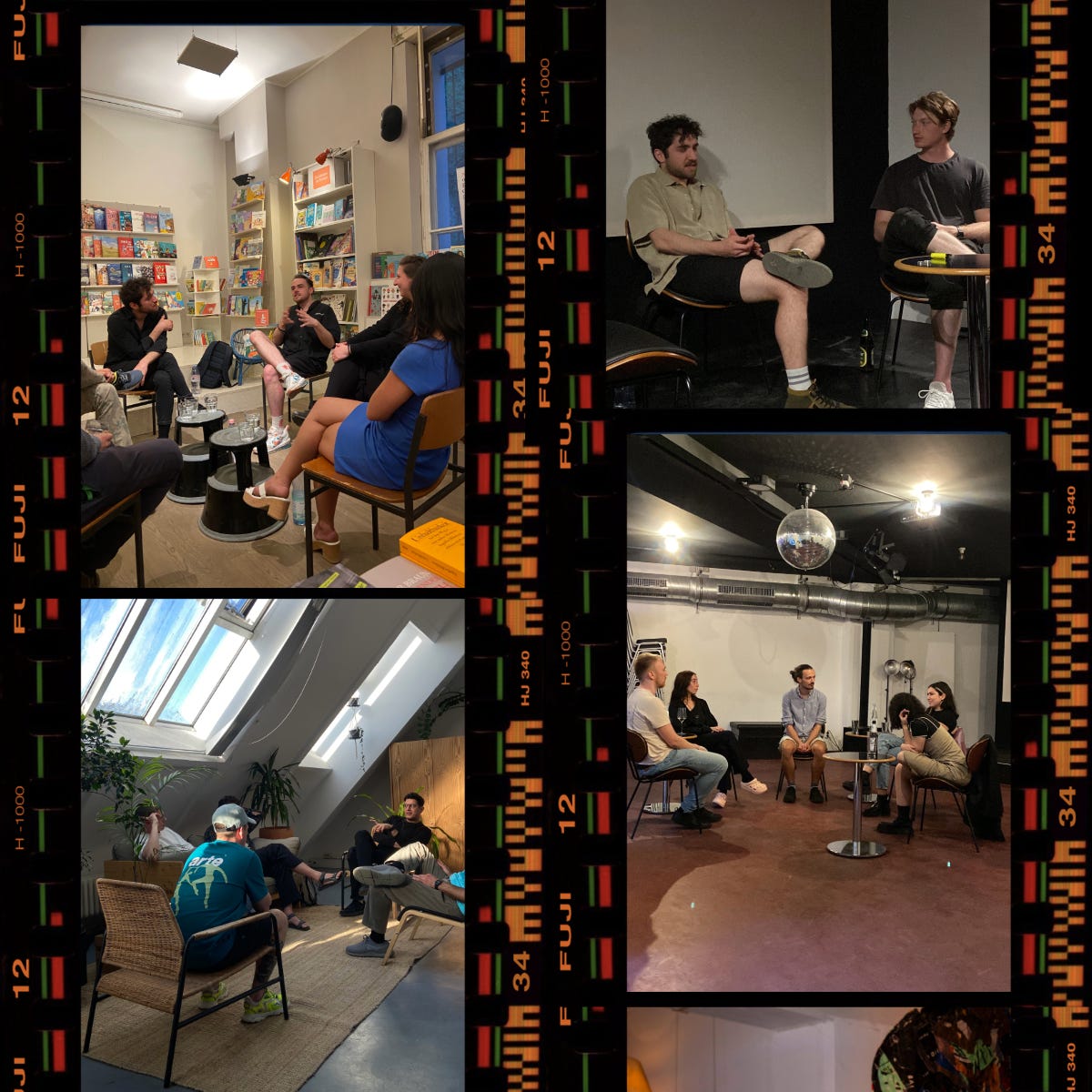
Dyad started as Dare. We designed an ugly duckling version of what we had in mind online and invited people to curated conversations. A topic, a question and four to eight people who wanted to meet to talk about it. Our first users, two hundred of them, have taken something so humble, and turned it into something extraordinary.
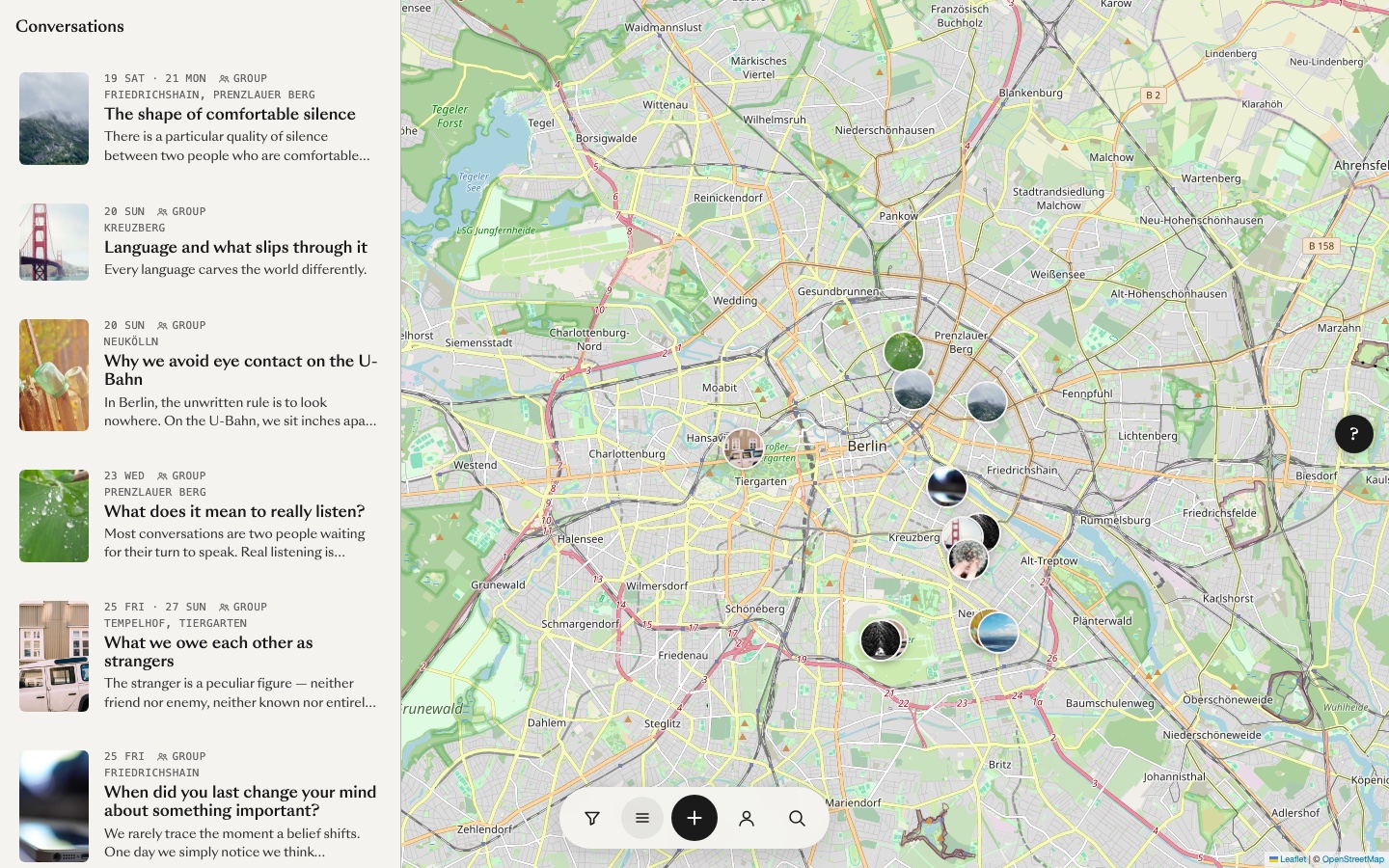
Over a hundred conversations, all across Berlin. We were flooded with people who had felt what we felt to begin with. We connected, conversed, and brought layers to our thinking behind the product, the editorial, and our public programming.
Dyad is now on its private beta and opens in Berlin for face to face conversations. We have a vision for an ecosystem in service to community and collective sensemaking. That is to say, Dyad, the web app to start and surface face to face conversations, is only the beginning.
Over the past two years now, we have been meticulously at work. Working first to understand how we arrived at a digital environment that feels so intrusive, hostile, exhausting, and then, working on something precious, full of life by virtue of serving the life within. Dyad is the product of such care and intention.
We did not like how being social online felt. We lacked the humanity the platforms we meet on allowed for. We are stripped down to a certain version of ourselves, and not the version we wanted come forth. The complexity of our experiences, the intricacy of making sense of them, and with that, discovering and nurturing the meaning of our lives. Where do you go online to expand, deepen, texture?
A face to face conversation is part of the oral culture we only recently parted ways with. Stories and conversations have so long been how we weave parts of us together. And we wanted to give way to more of them.
Dyad started as Dare. We designed an ugly duckling version of what we had in mind online and invited people to curated conversations. A topic, a question and four to eight people who wanted to meet for that. Our first users, two hundred of them, have taken something so humble, that was the private alpha of our product, and turned it into something extraordinary.
Over a hundred conversations, all across Berlin. We flooded with people who had felt what we felt to begin with. We connected, conversed, and brought layers to our thinking behind the product.
Dyad is now on its private beta and opens in Berlin for one on one conversations. We have a vision for an ecosystem in service to connection and collective sensemaking that brightens up our eyes every time we zoom out and circle back. That is to say, Dyad, the app to start and surface face to face conversations is only the beginning.
Although simple at face value, there is not a single decision that went into the making of Dyad that we have not deliberately thought about. A select few are worth voicing.
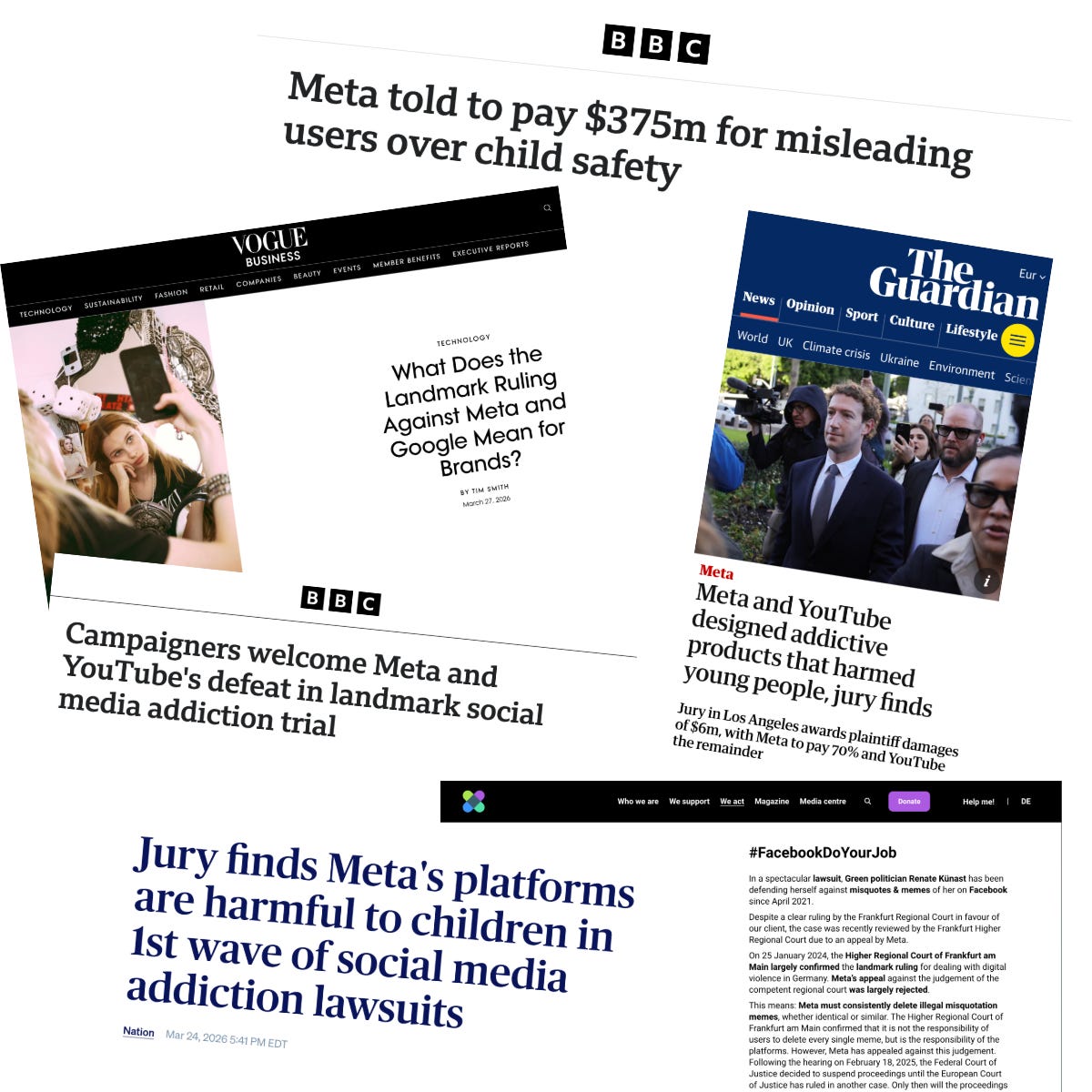
Dyad is a hyper local, curated network. This is among the many decisions we took to bend the overwhelm of the internet. The March 2026 verdicts against Meta and YouTube are the culmination of decades of work on digital rights and privacy and affirm that platform design is intentional and liable to its effects. With that, we situate ourselves within a countermovement to the commodification and surveillance that have come to define much of the internet. We approach our work not merely as social technology, but as a living infrastructure for connection and sensemaking, drawing from the deep traditions of inquiry, expression, and creation.
Dyad is set to transition into steward ownership. A root cause that takes a big part in explaining how social platforms begin with a niche, do great service, and end up as extractive technologies with agendas of their own lies in their corporate ownership structure. Traditional corporate models, by design, do not allow operational decision making to sit separate from shareholder interests, interests that are solely monetary. With that, the mission is diluted in the pursuit of ever greater profits. Steward ownership offers a different foundation. It is grounded in self governance and treats profit as a means in service of purpose. In practice, our investors do not hold equity, nor do they have a say in our operational decision making. We believe it is our acts rather than our words that does the difference with such critical considerations. The choice of steward ownership is one of those acts.
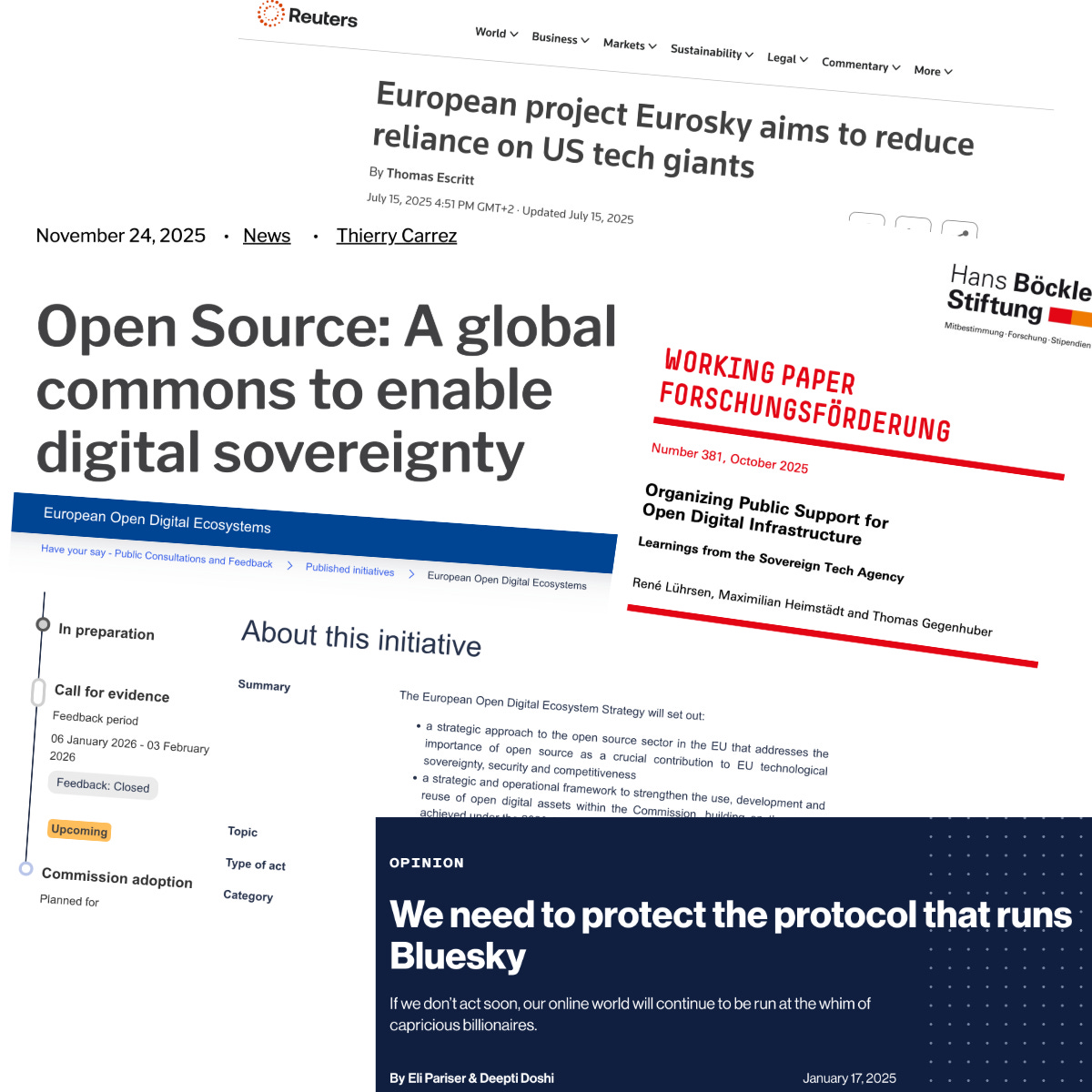
Dyad is built on a framework that follows the open and decentralised original intentions of the web. The fact that we do not yet own the data we create online and how little we know and can affect of the collection, archival, and usage of this information is absolutely bonkers. We nest ourselves in the movement towards open, decentralised infrastructure that makes these matters right. With that, we follow the lineage of internet’s architects.
We feel that in speaking our minds as we build Dyad, we give the most honest insider view into what is happening inside the community.
A central claim I hold in explaining the state of the world where we seem increasingly torn apart and unable to arrive at a shared understanding of what it means to be human is that instrumental rationality has come to dominate areas of life that are organic, therefore relational and emergent. Insisting on means–ends thinking in domains of life that are not mechanistic is alarmingly similar to an organ transplant gone wrong. And before we lose the patient, that is our capacities for individual and collective sensemaking critical to our species’ survival and flourishing, we got to course correct.
Beginnings are openings
About two years ago, I had a much appreciated encounter with Richard Reitlinger and Isolde Sammer where I’ve been a host at their family home just outside Hamburg. Over breakfast, we had a conversation which touched upon how you build a narrative arc and lately, I’ve been coming back to Richard’s remark on how good stories begin with a loss. As it happens, it would only click retrospectively that Dyad, too, came from such a place.
The arc my work emerges out of a journey to understand how the current state of affairs run in the making and captivation of the digital social landscape and, once I arrived at a certain depth there, turned into creating alternatives. I knew I was being harmed by the social media platforms I’ve been using and had withdrawn from nearly all. But, the catalyst, loss of my own sensemaking and sense of belonging was not until October, 2023 with the noticing that so many of us default into side taking at the breakdown of yet another war. I was agitated.
Why do we still cause so much unavoidable pain and violence? What causes nuance and constructive dialog to evasporate? What is the role of the public when it comes to such decisions that harm so many lives indefinitely? What does this say about our morals, capacities for collective action, and the functioning of our democracies? What does this make visible about our institutions? Is there a thread between the shortening of our attention spans and digital addictions with the polarization of our societies?
Having such a revolting kick off point, unmoored from a market analysis or a clear cut plan, already had me on the fringes of the society as I knew it. I felt disconnected from almost all circles I had a foot in. Soon enough, a choir of worried voices gathered in my head questioning whether I really know what I’m doing here. You should have a grasp of the destination at the moment of departure, they claimed rushing me forward so that I’d have quantifiable markers to justify the time I’m taking on such a matter. They demanded certainty and safety, or a good illusion of it like we most often settle with.
I had a very strong urge to keep walking on this path I set myself on and looking back, without that intensity of it, I would have caved in and take on another nine to five job way back. That very urge has also been my anchor and mirror, as I stood my ground and looked at those voice that claimed certainty. And I come to notice them for what they were, a product of conditioning that owes its existence to centuries of spillover of the instrumental logic into parts of our lives that do not have a suitable modus operandi for it. This modal confusion, that is approaching our being needs in the having mode, in Erich Fromm’s terms, sits at the root of so much of our problems.
Blake’s frontispiece to The Song of Los.
Within the logic of instrumentality, we strive to effectively and efficiently make use of means to reach a predetermined end. Hannah Arendt makes the distinction in saying it is fabrication that follows this logic whereas action, by contrast, unfolds in relation. It cannot be fully predicted, controlled, or contained. It belongs to the space between people, and to beginnings. So by its nature, we take action without a hold of the destination.
Embodying this with time has been given the choir of mine a rest and I move with ease. But I cannot stop thinking about how this narrative that demands certainty from the get go is harming us. Where else has instrumental rationality spilled into? How many of us are not taking the courage of our convictions to take action on problems we care about? What is the psychological bill on the pressure this creates? What possibilities are we foreclosing? And, how can we build capacities to hold ambiguity that is essential to our lives so that this loss can turn into action and birth stories as we go?
How do we know what we know?
That power in human societies organizes itself through hierarchies is well known to us. It is the breadth of the web through which it secures its place and the cost at which it clings on even as the conditions that once gave rise to it are steadily unraveling, that I find astonishing.
As I zoomed out from my own experience, I’ve come to notice how instrumental rationality depends on, and in turn, reinforces a mindset that insists on measurability, prediction, and optimization. As power has a hard time accepting one of the few concepts that does not discriminate, impermanence, it looks for ever more strength. The more widely this way of thinking is adopted, independent of context, the more stable the system that perpetuates the dominant becomes.
This logic does not remain confined to the production line or the boardroom. It travels. It infiltrates. It builds alliances with those who benefit from existing distributions of power. And in doing so, it concentrates power further.
Across domains, what lends itself to measurement, prediction, and control is consistently elevated.
Thomas Cole’s Destruction (1836), the fourth painting in The Course of Empire.
The endurance of instrumental logic is therefore not maintained by economics alone, but by a broader architecture of meaning-making: the ways we are taught to think, be, and make sense of the world. Through its overarching and intrusive effort, its logic seeps into education, epistemology, institutions, and everyday decision-making. The logic that governs production begins to govern thought itself. At a certain point, it becomes so pervasive that we no longer experience it as a system at all, only as reality.
Two young fish are swimming along when they pass an older fish who nods at them and says, Morning, boys. How’s the water? The two young fish swim on for a while, and eventually one of them looks over at the other and asks, What the hell is water?
David Foster Wallace, on Infinite Jest
The problem with subordinating ourselves to a hierarchy of knowing is not only that it narrows the ways we relate to ourselves, each other and our environment but that it becomes the ground we stand on. What is elevated over time comes to dominate, and what dominates begins to feel unquestionable. It settles into the background of our lives, passing itself off as the fabric of reality.
Among all the domains that means-ends thinking has infiltrated, epistemology holds a root position. How we know what we know is not only about knowledge. It shapes the stance from which we encounter the world and, with it, the entirety of our lived experience. When a single way of knowing takes hold, it introduces hierarchies that reorganize our perception, relation, and action.
It is on this ground systems increasingly misaligned with the organic, relational nature of life emerge. Systems that go so far as to treat our very mindspace as a means to their ends.
The insidiousness and audacity of behavioral futures market
I’ve already touched on power’s attempt at securing itself through accumulation and expansion. A second, more cunning way it claims permanence is by evading scrutiny, by making its legitimacy difficult to question. What is not seen is really hard to question and hold accountable, which brings us swiftly to surveillance capitalist logic. The economic system that’s based on widespread collection and commodification of personal data by corporations.
In her comprehensive account of surveillance capitalism in The Age of Surveillance Capitalism: The Fight for a Human Future at the New Frontier of Power, Shoshana Zuboff highlights how this unnoticing is not incidental, but engineered. Drawing on cases mainly from Facebook and Google, she shows how the tools we use and the infrastructures they rest on are deliberately designed to obscure the very operations that make them profitable. Surveillance works best when it becomes invisible and significant resources goes into the making and sustenance of its cloak.
Here’s that protective instinct again. The scale and scope of these operations are still relatively new to my understanding, and in that I find myself returning to those who remain in the dark or who simply do not have the means to resist. The audacity of the harm, the deceitful breaking of boundaries is unacceptable. And words come closer to express the possible damage we are talking about here as Zuboff draws the parallels between industrial and surveillance capitalism and says, surveillance capitalism is to human nature what industrial capitalism has been to nature.
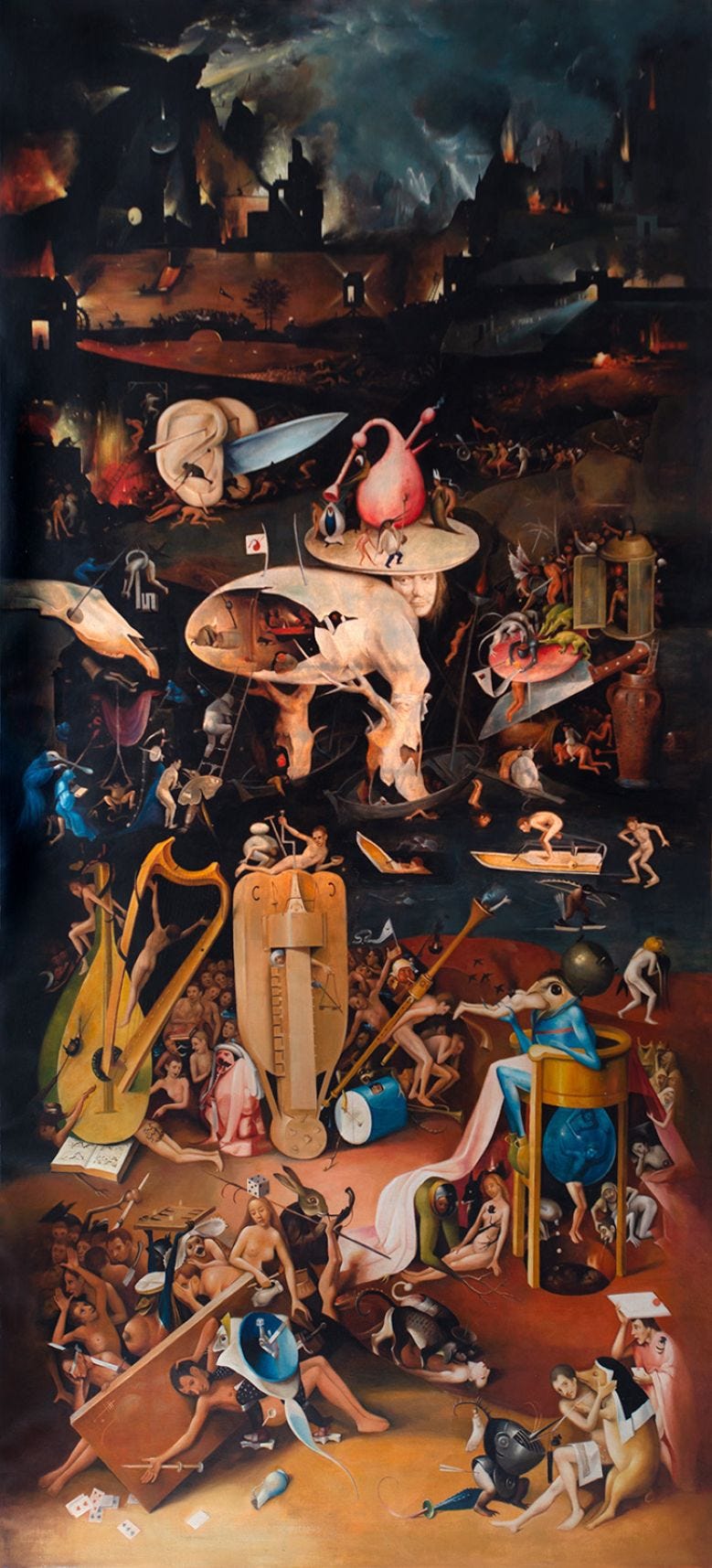
Hieronymus Bosch, The Garden of Earthly Delights (c. 1490–1510), right panel.
One of the ways this logic secures its dominance is through the institutionalization of certainty as both promise and product. What presents itself as safety or stability is, more often, a carefully constructed illusion, one that masks the underlying asymmetries of knowledge and power. In turning toward these assurances, we gradually relinquish our capacity to endure uncertainty. And as that capacity diminishes, dependency deepens and we become increasingly reliant on the very systems whose operations remain opaque, yet whose authority over our experience continues to expand.
The need to know the destination at the moment of departure then is not an individual shortcoming. It is a learned orientation that aligns seamlessly with a system built on prediction, control, and the continuous reduction of the unknown.
And when this orientation is reinforced at scale, we begin to inhabit a world that quietly weakens our ability to live with or in change, an essential condition of any organic, living system.
Towards a life affirming collective life
Life, in its social, psychological, and ecological dimensions is organic, relational, and emergent. And that calls for a different kind of thinking than what came to dominate. One less concerned with predetermined outcomes and more attentive to unfolding processes. The work of alignment here asks of us patience with uncertainty, sensitivity to context, and a willingness to remain with questions long enough.
If instrumental logic has extended its reach by flattening context and elevating abstraction, then a life-affirming collective life depends on restoring our capacity for contextual judgment, nuanced thought and exchange, tender and embodied senses. It requires that we keep questioning the hierarchies we inherit, refusing to grant them legitimacy by default.
To reclaim the sovereignty of our minds and the conditions of our collective life is not a singular act, but an ongoing practice. It unfolds wherever we resist premature closure, wherever we choose relation over reduction, wherever we allow complexity to remain without forcing it into false clarity.
In this sense, any action we dare to take and sustain our attention, expand our circle of care and relation, harbor space for nuance and the in between, as well as holding power accountable, moves us in that direction.